
Bringing in an IT contractor might seem more expensive than hiring someone yourself. After all, an external consultant’s day rate doesn’t easily compare with a permanent employee’s gross salary. But that comparison says little about the actual costs involved. Specialist IT profiles are scarce and often come with a high salary. Then there are the costs of recruitment, training, absences and staff turnover. If you want an accurate financial assessment, you need to look at the total cost of ownership (TCO): all the costs involved in having, and keeping, the right expertise available.
Kenny Van Eycken, Operations Manager Professional Services at Cheops Technology, and Giel Verhelst, Regional Sales Manager at Cheops Technology, explain which costs companies often overlook and how they can better align their IT capacity with their needs.
What are the hidden costs of an in-house IT employee?
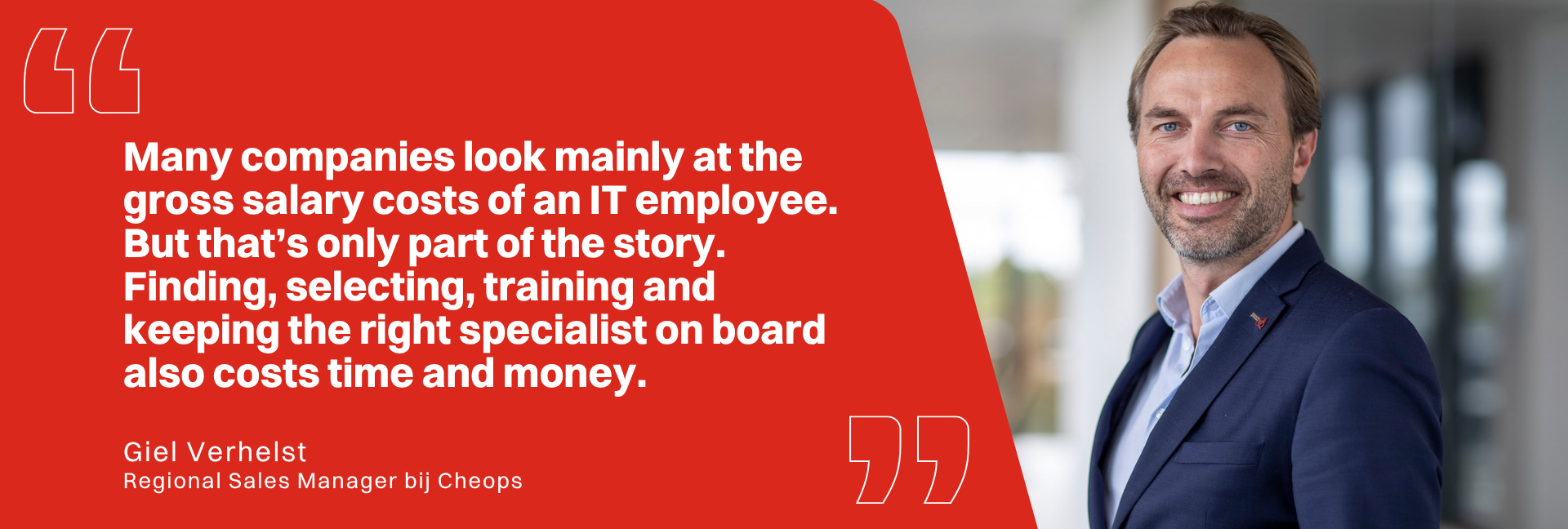
Finding a specialist IT employee takes time and money. Companies invest in job adverts, recruitment campaigns and employer branding to attract the right candidates. Next come the interviews involving both HR and the IT department. For technical profiles in particular, this is a labour-intensive process. An HR recruiter often carries out the initial screening, and may have been looking for a finance profile the day before. This makes accurately assessing a candidate’s technical expertise far from straightforward.
Once hired, onboarding begins. A new IT employee has to get to know the existing infrastructure, applications and interdependencies before they can work independently. It also takes time for an IT expert to get up to speed, but Cheops selects its experts specifically based on the client’s technical environment and needs. Thanks to their experience in similar environments, they’re usually quicker at getting started. Meanwhile, an internal employee’s salary costs keep adding up, including employer contributions and extra-legal benefits.
Staff turnover has a price too. When an in-house IT specialist leaves, you have to start the search all over again. On top of that, the knowledge they built up leaves with them. In smaller IT teams in particular, where certain systems are sometimes managed by one person for years, this is a considerable risk.
Cheops works with recruiters who specialise in profiles such as cloud and security engineers and enterprise architects. They understand the technical requirements and have a specialized network in each field, allowing them to identify and propose suitable candidates more quickly.
How much does it cost to keep IT expertise up to date?
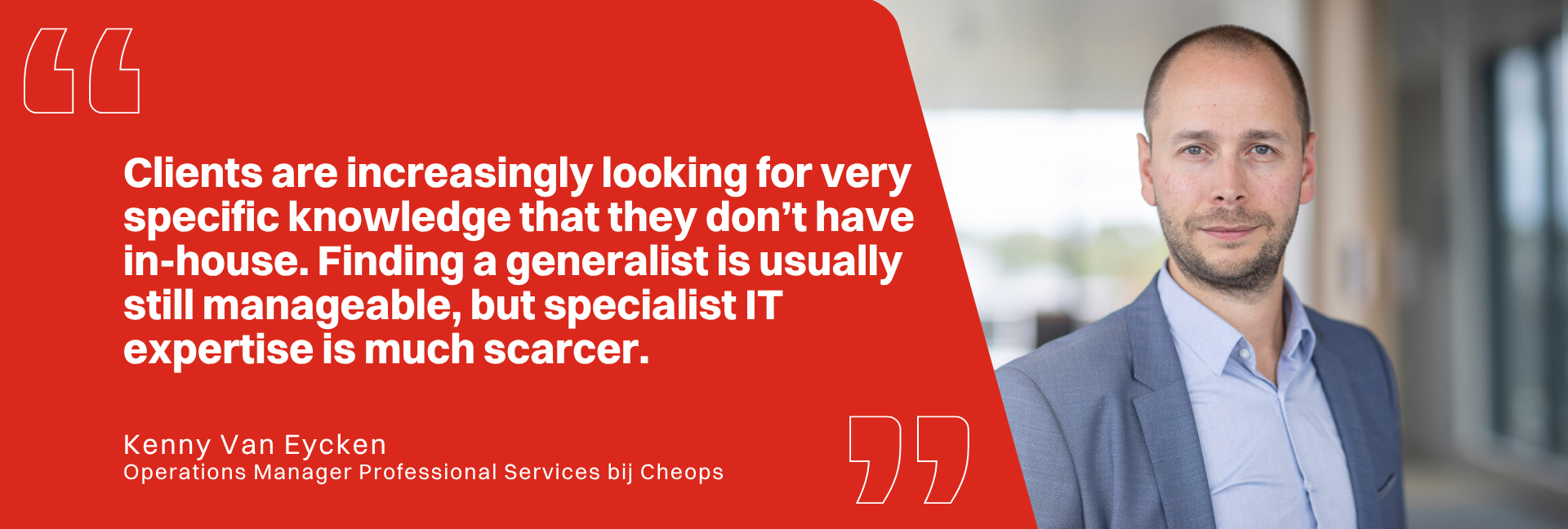
The labour market is shifting from a ‘war for talent’ to a ‘war for expertise’. Companies are looking for specialists with in-depth knowledge of cloud, cybersecurity, enterprise architecture, workplace and compliance. These profiles are hard to find and often come with a high salary. What’s more, progression from junior to senior is becoming increasingly difficult, which makes the shortage of experienced specialists harder to absorb.
AI makes IT teams more productive, but doesn’t remove the need for specialist knowledge. At the same time, technologies and regulations are constantly changing. If you’re building up this kind of expertise in-house, you need to continue investing in training, certifications and the time employees need to keep their knowledge up to date.
Cheops supports the professional development of its employees through the Cheops Academy, which offers technical training and certification programmes. Depending on their profile, experts complete an average of five to fifteen training days per year.
Every expert is also assigned their own Talent Manager. They provide career guidance, monitor the expert’s skills and help decide which training and future projects align with their development.
Cheops experts also bring in experience from other client environments. They apply proven ways of working and help link technical choices to organisational needs. This bolsters the internal IT team with knowledge that isn’t always available within the organisation itself.
With more than 400 certified IT experts, Cheops offers a broad range of skills. This gives clients access to specialist knowledge without having to go through a full recruitment and training process themselves.
How do you match IT capacity to actual need?
An in-house employee is generally on the payroll full-time, even when there is temporarily less need for their specific expertise.
Take an IT architect who has to design a new environment. During the analysis and design phase, they might work full-time on the project. Once implementation begins, engineers take over a larger share of the work. After that, it may be enough to bring in the architect for, say, one or two days a week.
That flexibility doesn’t mean contracting is always short-term. At Cheops, a consultant is sometimes initially brought in for three months, for example to cover a vacancy temporarily. Three years later, that same expert is still working for the client. A collaboration that begins with one specialist can therefore grow into a long-term partnership in which Cheops evolves alongside the client’s needs. Over that period, the organisation has found that the expertise, support and flexibility of the IT consultancy model fit its needs and specialist challenges well.
Flexibility like this limits the cost of unused capacity. Organisations can scale their IT team up or down in line with their current needs, for example during an acquisition, a major IT project or a change in their IT organisation.
How do you ensure the continuity of your IT team?
An in-house IT specialist isn’t available every working day. Annual leave, illness or an unexpected departure all affect team capacity. In smaller IT teams, specialist knowledge sometimes rests with one or two key people. When one of them leaves, it creates a knowledge gap that is difficult and expensive to fill.
Cheops offers four options for aligning IT consultants with the capacity and continuity you need:
- Engage: a pre-agreed number of days of support, for example two days a week.
- Smart: an option with guaranteed continuity for 213 days a year.
- Focus: coverage for 251 working days a year, including a replacement in case of absence.
- Managed Team: a fully assembled IT team, with the option of a team lead from Cheops.
As the client, you stay in control, while Cheops provides the additional expertise, capacity and ability to deliver. Depending on the option you choose, Cheops aims to put in place an SLA (service level agreement) covering availability and staffing to guarantee the continuity of the IT team.
These continuity models reduce dependence on any one person. Cheops has experts who can step in during an absence, and places a strong emphasis on documentation and knowledge transfer. Take Frans, who has worked at the same company for fifteen years and knows exactly how every system functions. When he retires or leaves the company, much of that knowledge will be lost. By documenting the work carefully and transferring knowledge, Cheops helps keep that valuable expertise within the company.
When is it better to hire in-house?
External expertise isn’t the most cost-effective solution in every situation. When an organisation is looking for someone to manage a highly specific, in-house application for years, an internal hire is the more logical choice.
For expertise in areas such as cloud, workplace, security, applications, data and AI, Cheops offers an alternative. The organisation pays for the capacity it needs, while also benefiting from the recruitment, training and support that Cheops arranges for its experts.
Find out what your IT experts really cost
Request a TCO analysis